
Pieter Levels Plans to Share a 10,000-Plus AI Spam Blocklist
Pieter Levels says he plans to publish more than 10,000 accounts he has blocked as suspected AI reply spammers. A shared blocklist could help readers clean up their replies, but the count and classifications are his claims—and a public list could spread mistakes as quickly as it spreads protection.

The actual story.
Pieter Levels says he plans to turn his personal blocklist into a public resource. In a post on X, he announced that he would share more than 10,000 accounts he has blocked as suspected AI reply spammers so other users can block them too.
The number and the description of those accounts come from Levels. His post announces a planned release; it does not establish that a downloadable dataset has been published, independently audited or verified.
Loading this post connects your browser to X. X’s privacy policy applies.
The pitch is simple: make the cost of automated reply spam extend beyond one blocked conversation. If other people adopt the same list, accounts on it could lose access to more audiences. That is a possible consequence of users choosing to block them, not a guarantee that X will suspend or delete those accounts.
What X actually allows
X’s automation rules distinguish permitted automation from unsolicited spam. AI reply bots require prior explicit written approval from X and must comply with its other rules. Automated replies generally require a recipient to opt in, an easy opt-out and a limit of one reply per interaction. Unsolicited automated replies sent to large numbers of users are prohibited.
The false-positive problem
A shared list is only as reliable as its classifications. A human writing generic replies could be mistaken for a bot; an approved bot could be confused with a spam account. Without transparent criteria and a correction process, a mistaken label could travel to every person who adopts the list. Inclusion would not, by itself, prove an account violated X’s rules.
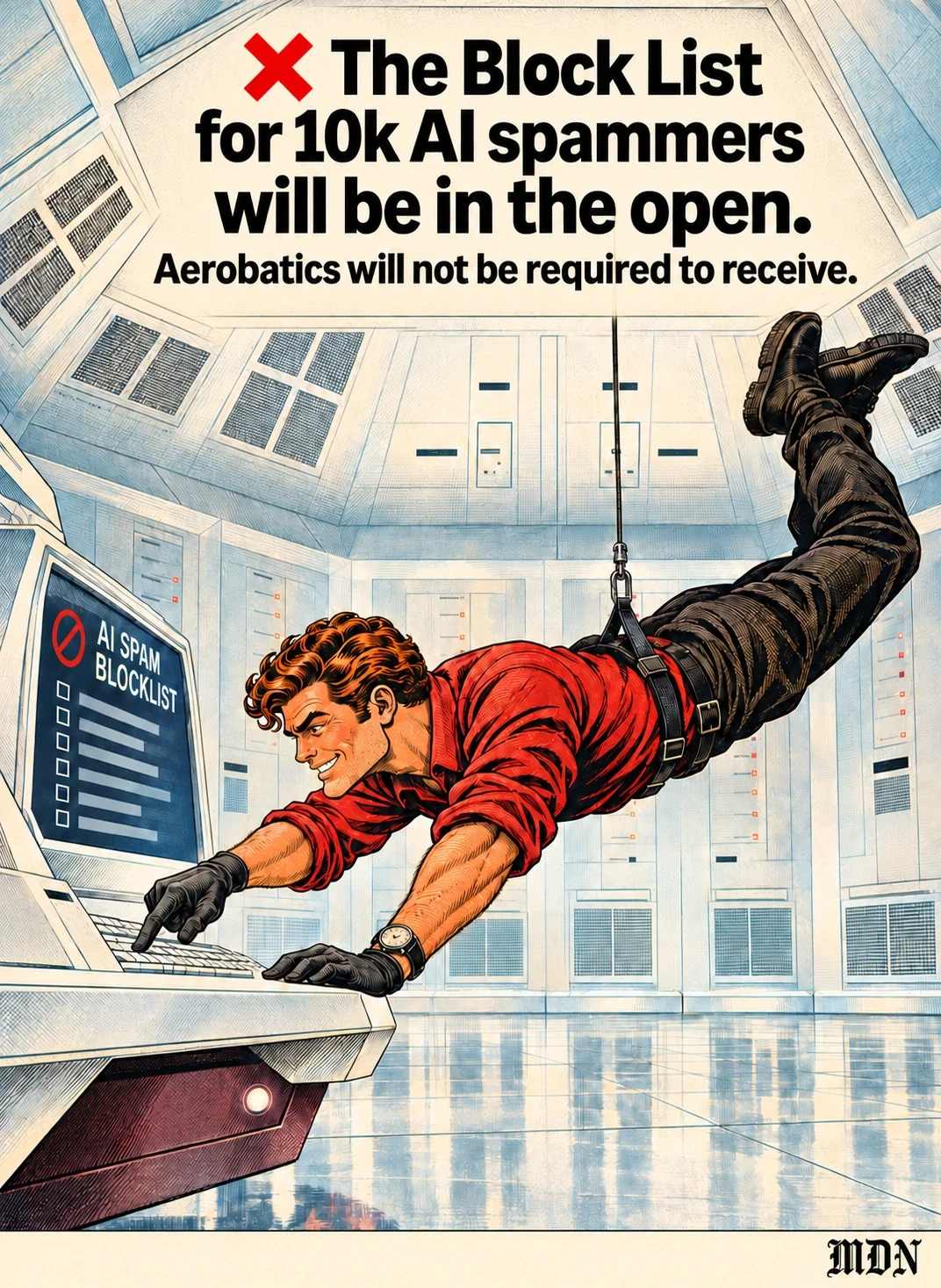
For now, the story is an announced plan for a crowd-distributed filter. Whether it becomes a useful anti-spam tool depends on what Levels releases, how accounts are identified and whether errors can be corrected. The Collector’s vault mission is editorial illustration, not evidence of a released list.
A well-maintained blocklist could help creators spend less time filtering spam and more time building conversations. Its value will depend on how accurately accounts are identified and how easily mistakes can be corrected.
Receipts, not rumors.
Read the original reporting: Pieter Levels on X
The reporting above provides context. Illustrations are editorial interpretations, not source photographs.
What’s your take?