Railway Warns of Exposed Secrets: What Developers Need to Revoke Now
Reporting cutoff: October 22, 2026, 04:42 UTC / October 21, 2026, 9:42 p.m. PDT.
The actual story.
What Railway disclosed
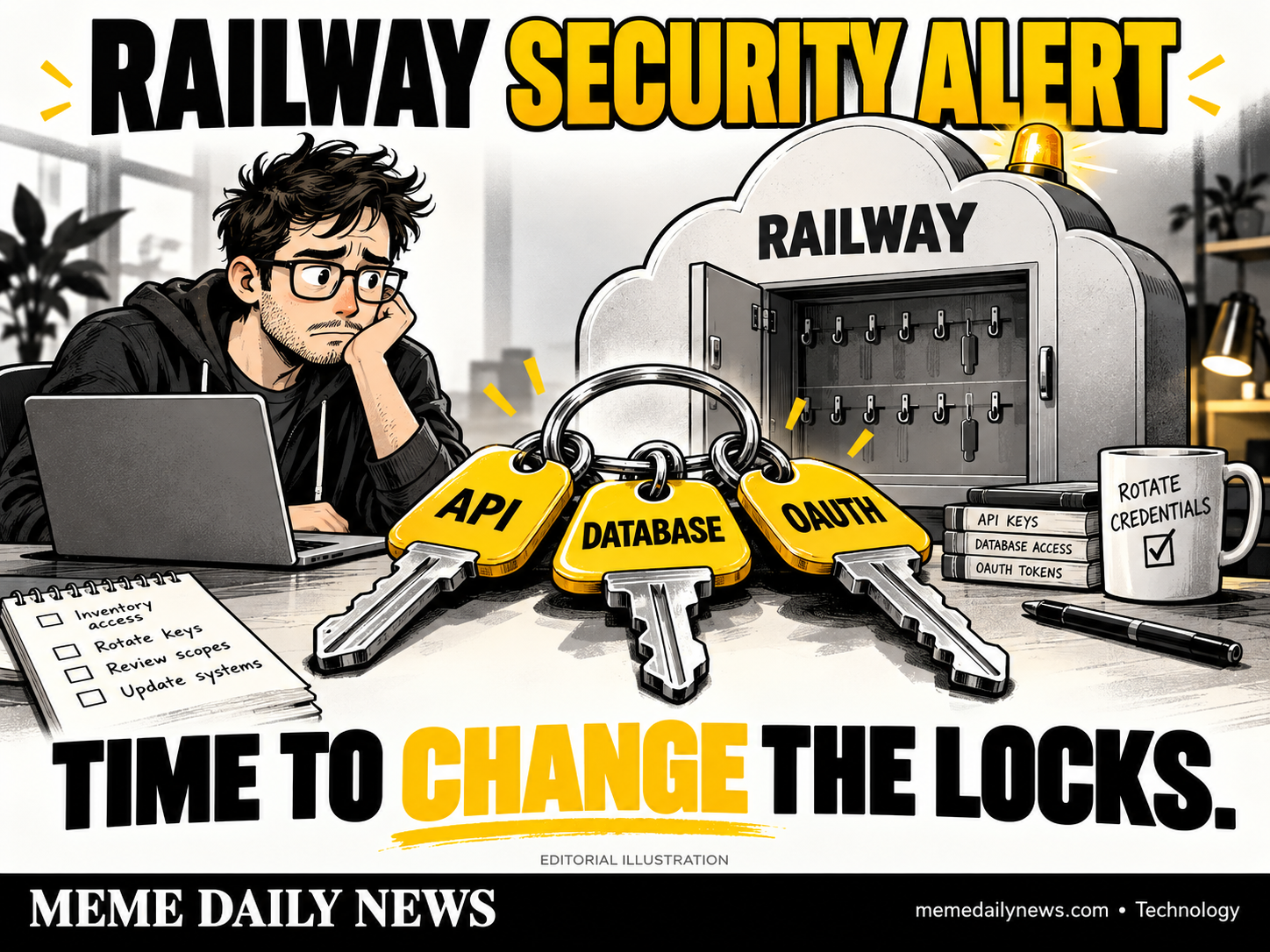
Railway is urging every customer to replace credentials stored on its platform after detecting suspicious activity involving systems that hold application environment variables. Its October 21 disclosure says an unauthorized party may have accessed encrypted variables and obtained some decrypted contents. Those variables can contain API keys, database passwords and private registry credentials.
Railway’s initial assessment suggests a subset of users may be affected, but its precautionary advice applies to everyone. The company says it will email customers as affected accounts are confirmed. It also suspects a connection to attacks targeting AI inference providers; that remains Railway’s assessment, not an independently established attribution. Railway security disclosure
The immediate concern is what an exposed credential permits someone to do. A key used by one application may authorize activity in a different company’s service, making the response broader than a Railway password change.
What is working now
At 04:17 UTC on October 22, Railway said it had invalidated all Railway API tokens. Integrations using its public API need replacement tokens. Enterprise builds had resumed at 03:32 UTC, but restoration for Pro, Hobby, Free and Trial plans had not yet been confirmed at this article’s reporting cutoff.
There is also an important interface exception: Railway’s 04:00 UTC update said the normal Redeploy feature was unavailable. Where builds are enabled, its workaround is to open the service, use Ctrl/Cmd+K and select Deploy Latest Commit. Readers should check the live incident page before attempting recovery because availability can change.
At 04:39 UTC, Railway reported that services with pre-deploy commands were getting stuck at the “Running pre-deploy command” stage. It said it was investigating and working on a fix. Railway incident update
Which credentials need attention
Railway’s warning covers secrets stored in environment variables and private registry credentials, not only the tokens used to manage Railway itself. Its recommendation is to rotate them and inspect the corresponding services for unusual activity. Railway disclosure
Some resets have already happened. Railway says it regenerated credentials for every storage bucket and invalidated the tokens it held for GitHub account connections. Applications using bucket credentials need a new deployment to load the replacements. Connections to GitHub must be restored, and credentials used outside Railway need updating too.
GitHub registry tokens require special care. Railway removed those credentials from its services, but removal did not revoke the tokens on GitHub. Developers must revoke them there and configure replacements before pulling private images again. Deleting a saved secret from one platform is not necessarily the same as disabling it at its issuer. Railway bucket and GitHub recovery guide
Why this does not automatically mean a Google password leaked
An application’s Google OAuth client secret is distinct from a person’s Google password and from the access tokens issued for that person. Google’s documentation explains that access tokens authorize particular resources and operations, while refresh tokens can obtain new access tokens. A client secret alone is not blanket access to every user’s Google account. Google OAuth documentation
That distinction does not make exposed application credentials harmless. If an attacker also obtained usable user tokens, the permissions attached to those tokens would matter. A database credential could separately create a route to customer information if its permissions and network access allowed it. These are conditional risks, not evidence that customer records or Google accounts were accessed in this incident. Railway’s disclosure does not establish either outcome.
Check usage as well as replacing keys
For OpenAI integrations, Railway recommends revoking potentially exposed keys, creating replacements, updating the application and checking that the new deployment makes successful requests. Its guide also calls for reviewing usage and billing, comparing activity by key and project with expected traffic, and preserving suspicious details for support. Where available, audit logs can help identify unexpected account or project changes. Railway’s OpenAI recovery guide
Revocation can interrupt an application before a replacement deployment is possible. The build outage makes that recovery harder; a broken integration does not, by itself, prove malicious use. Keep a record of which credentials were revoked, which replacements are configured and which services have actually restarted successfully.
What remains unknown
Railway has not published a final affected-account count in the disclosure reviewed here. Treat recovery as unfinished until the old credentials are disabled, replacement deployments work and suspicious activity has been investigated. A successful restart answers an availability question; it does not settle what happened before the reset.
Treat recovery as unfinished until the old credentials are disabled, replacement deployments work and suspicious activity has been investigated. A successful restart answers an availability question; it does not settle what happened before the reset.
Receipts, not rumors.
Railway security disclosure, October 21, 2026
Railway incident timeline, checked October 22, 2026
Railway bucket and GitHub recovery guide, October 22, 2026
Railway OpenAI usage guide, October 22, 2026
Google OAuth 2.0 documentation
Read the original reporting: Railway security disclosure ↗
The reporting above provides context. Illustrations are editorial interpretations, not source photographs. The copy and illustration were created with AI session tools from the linked source.
Got a better punchline?