Your Startup Raised Millions. How Much Do You Actually Keep?
A founder’s stake, a company’s valuation and a personal payday are three different numbers. A widely shared study puts that gap under the microscope.
A fundraising announcement tells you how much money went into a company. It does not tell you how much its founder will eventually take home.
That distinction is behind a striking statistic circulating on X: an estimate that 88% of venture-backed founders receive no exit-equity proceeds. Callum Williams highlighted the finding in a post that Sam Parr reposted.
What the study actually estimates
The source is Dilution vs. Risk Taking: Capital Gains Taxes and Entrepreneurship, by Eduardo M. Azevedo and Kent Smetters of Wharton, and Florian Scheuer and Min Yang of the University of Zurich. The linked version is dated July 2026.
Its individual founder payouts are simulated, not a census of personal bank receipts. Crucially, the benchmark assigns zero compensation to founders missing from IPO ownership disclosures. The authors acknowledge that some could have sold shares privately for substantial amounts or held stakes that were not disclosed. See printed pages 26–27.
The figure concerns VC-backed founders’ exit equity, not all entrepreneurs, salaries or lifetime earnings. Ongoing companies are treated separately rather than automatically counted as failures.
Three numbers that should not be confused
Money raised is capital for the business. Valuation is the price implied for the company by a transaction. A founder’s payday depends on what they own and what they actually receive.
Here is a simplified illustration, not a finding from the study: a founder who owns 10% of a company sold for $20 million might initially calculate a $2 million share. That arithmetic only works if the full sale price is available to distribute proportionately. Debt, investor payout rights, transaction costs and other deal terms can change the amount available to common shareholders. Taxes can further reduce take-home proceeds.
Nor does a fundraising valuation guarantee that a later buyer will pay the same price.
The question behind the headline
For a founder, “What is my company worth?” is only the beginning. The more useful questions are: What percentage will I still own? Who gets paid before me? And what would I receive under several realistic sale outcomes?
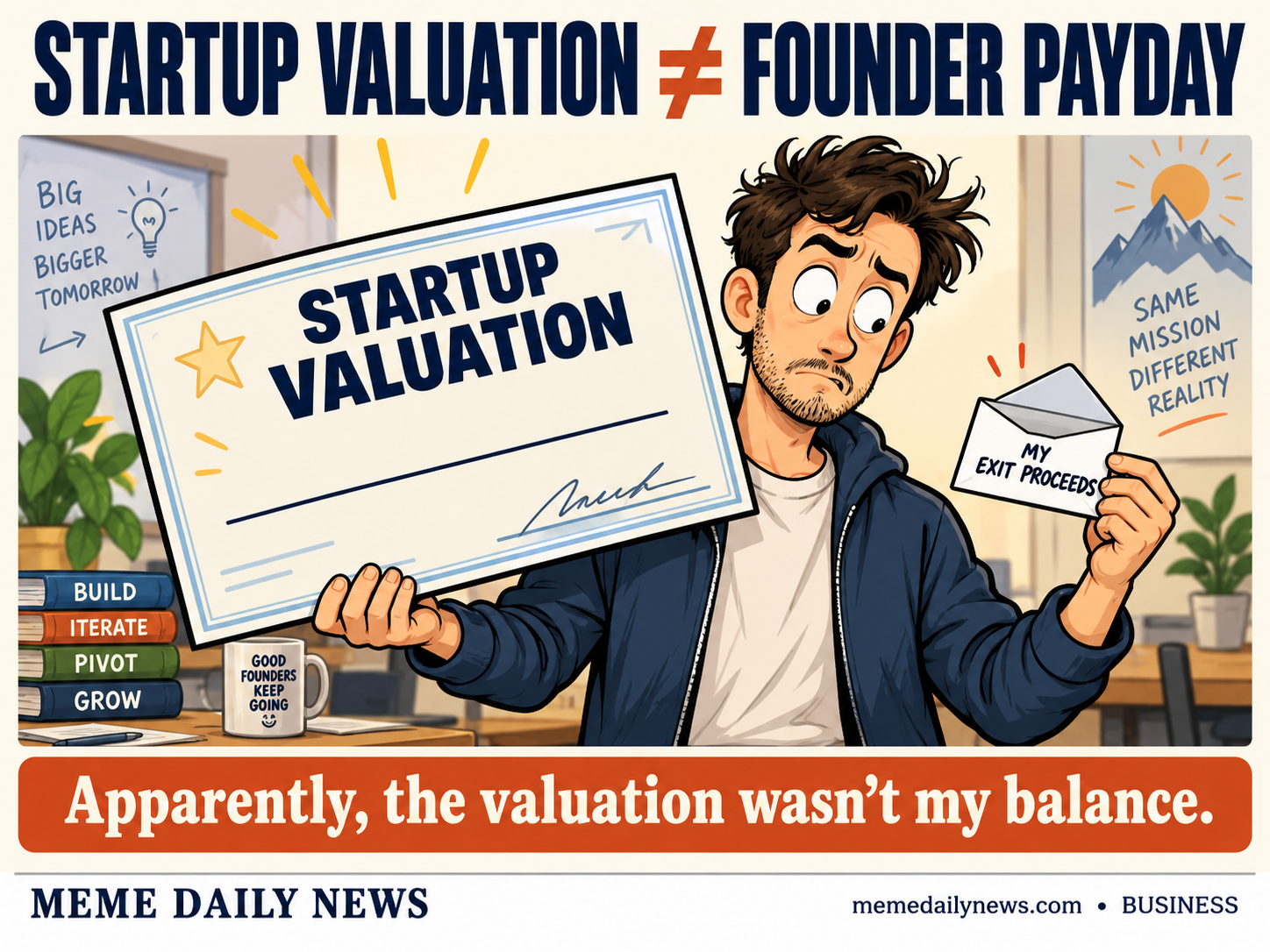
That is why the meme pairs an enormous valuation check with a small proceeds envelope. It is a visual joke about two different measures, not a claim that every startup founder ends up empty-handed.
The 88% estimate deserves attention, but its assumptions deserve space beside it. A company can attract capital without making its founder wealthy, and a founder’s financial outcome cannot be read from a fundraising headline alone.
Research credit: Azevedo, Scheuer, Smetters and Yang, July 2026 version; see especially printed pages 26–27 for founder payout construction and limitations. Social discovery: Callum Williams’s post, reposted by Sam Parr.
A fundraising valuation does not determine a founder’s personal proceeds.
Receipts, not rumors.
Read the original reporting: Azevedo, Scheuer, Smetters and Yang — July 2026 ↗
The reporting above provides context. Illustrations are editorial interpretations, not source photographs. A human editor approved this story and original visual.
Got a better punchline?