
What If Data Centers Moved Into Orbit?
What if the next data center orbited Earth? Blue Origin, SpaceX and Starcloud have proposed computing networks in space. Research and early experiments show why the idea is worth exploring—and why sunlight alone will not settle the business case.


The actual story.
What if some of the next wave of data centers orbited Earth instead of occupying land below? Blue Origin, SpaceX and Starcloud have filed proposals for computing networks in space, while researchers and early missions are testing the hardware, energy supply and communications those networks would need.
The appeal starts with sunlight. Suitable orbits can offer much more consistent solar-energy collection than many locations on Earth. But servers still need to shed heat, exchange data and survive radiation, and every piece of equipment must first be launched.
The question is not simply whether a computer can work in orbit. It is which workloads would benefit, what the whole system would cost, and whether operators could deliver reliable computing over its lifetime.
Three companies, three proposals
Blue Origin's Project Sunrise application requested up to 51,600 satellites between 500 and 1,800 km. Its filing narrative argues the system could reduce demand on terrestrial land, water and electricity.
SpaceX's application requested up to one million satellites between 500 and 2,000 km. Its proposed network uses optical links and Starlink.
Starcloud applied for up to 88,000 satellites, primarily in 600–850 km sun-synchronous orbits. Its Starcloud-1 precursor carried an NVIDIA H100 into orbit in 2025 and subsequently conducted AI experiments, according to the company.
These are application ceilings, not deployed fleets or a computing leaderboard. The filings describe proposed systems; they do not by themselves establish that the full constellations have been authorized or built.
Sunlight and cooling
Google's research estimates that solar panels in a suitable dawn-dusk orbit could collect up to eight times the annual energy of comparable panels at a midlatitude Earth location. This is a conditional annual energy comparison, not a claim that computing is eight times more efficient.
There is no air in space to carry heat away. As NASA's thermal-control guide explains, spacecraft must move heat internally and radiate it using engineered equipment. Radiators and supporting structures add mass and complexity; operational heat rejection may avoid freshwater cooling but is not free.
The pressure underneath the idea
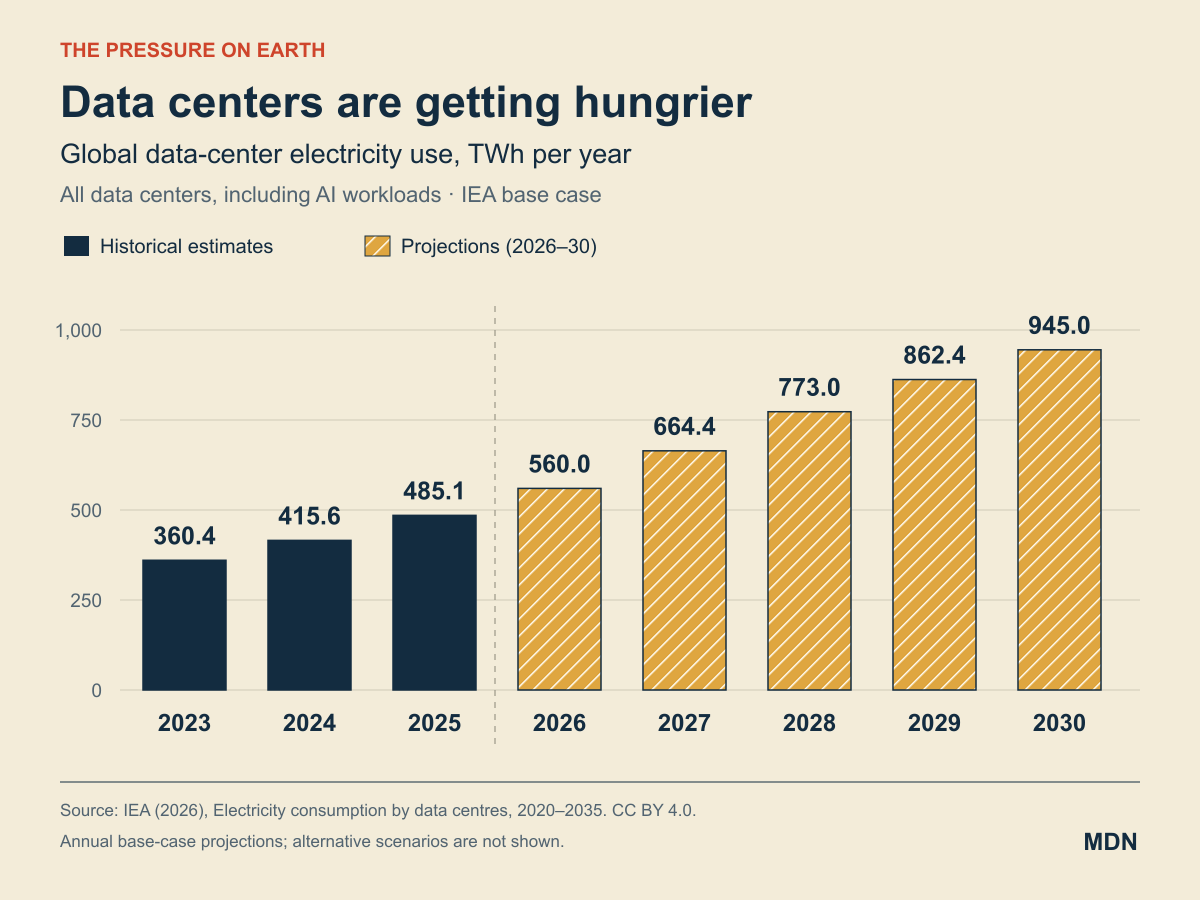
Data centers used an estimated 485 TWh worldwide in 2025, according to the International Energy Agency, which projects about 950 TWh in 2030. These figures cover all data centers, not just AI.
A Virginia legislative audit found economic benefits alongside concerns about future electricity costs, infrastructure investment and persistent noise near some facilities. Most facilities generated no noise complaints and water use varied substantially.
Data centers and the communities hosting them are not interchangeable. Orbital computing offers a way to relocate some pressures while introducing others.
Who might use it first?
Processing data where it is collected in space may be an early use. HPE reported an ISS experiment that reduced 22 GB of input to a 235 KB result for transmission, illustrating the advantage of sending an answer rather than every byte.
Serving Earth-based AI requires communications, networking and acceptable latency and cost. Our report on Google's orbital AI experiment examines one step in that direction. Demonstrations are steps toward a system, not proof of an operating replacement for terrestrial facilities.
The business case has to include the whole system
Compare the entire system, including launch, manufacturing, radiation protection, networking, service life, replacement and disposal. The ASCEND feasibility study concluded that substantial lifecycle carbon benefits require a launcher approximately ten times less emissive than the benchmark assessed. That is a condition, not proof today's launches are greener.
Large constellations must also manage orbital congestion. The decisive customer question is what useful computation costs over a system's life and how reliably it can be delivered.
Data centers in orbit could relieve some pressure on land, water and electricity networks. The strongest early use case may be processing data already collected in space. Serving Earth’s AI demand is a bigger bet: companies must prove that reliable computing can repay the costs of launch, communications, cooling and replacement. Watch paid workloads and delivered performance, not satellite counts alone.
Receipts, not rumors.
- IEA · Key Questions on Energy and AI
- Virginia JLARC · Data Centers in Virginia
- FCC · Blue Origin Project Sunrise filing notice
- FCC · SpaceX orbital data center application notice
- FCC · Starcloud application notice
- Starcloud · Starcloud-1 mission
- Google Research · space-based AI infrastructure design
- NASA · spacecraft thermal control
- HPE · Spaceborne Computer experiments
- Thales Alenia Space · ASCEND feasibility study
- Meme Daily News · Google's orbital AI experiment
Read the original reporting: International Energy Agency; FCC; company and research sources
The reporting above provides context. Illustrations are editorial interpretations, not source photographs.
What’s your take?