
Google put an AI chip in orbit. It sent back a haiku.
Google asked a satellite to write a poem about being in space. The answer came back as it passed Svalbard, Norway.

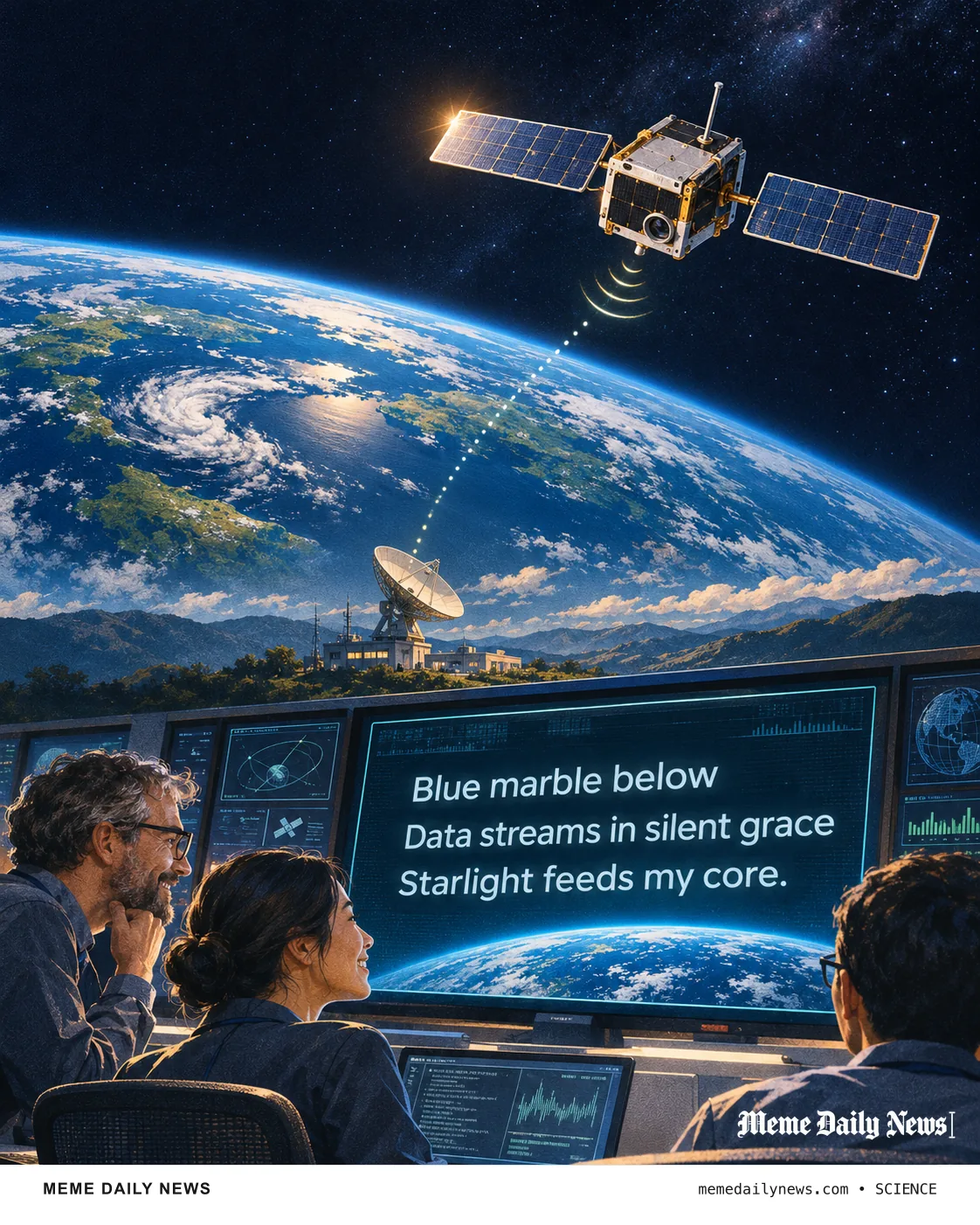
The actual story.
In an October 30 update, Google said its Project Suncatcher prototype ran the Gemma 4 model aboard an orbiting TPU, the company’s specialized machine-learning processor. The team describes the result as the first AI response from a data-center-class TPU in orbit. It followed commissioning work and early machine-learning tests. Subsequent prompts produced limericks and reports on the payload’s condition.
The satellite launched October 1 aboard SpaceX’s Transporter-18 rideshare mission. Built with Planet, it is part of a research program investigating whether space could eventually support machine-learning infrastructure at scale. Google says measurements from the mission will help refine its designs.
Why put the hardware in orbit?
Google’s proposed system design centers on solar-powered satellites in a suitable dawn–dusk, sun-synchronous orbit. Google’s technical paper says panels in suitable orbits can receive up to eight times more solar energy per year than a panel at Earth’s mid-latitudes. That compares annual energy collection, not instantaneous sunlight or chip efficiency. Near-continuous generation could reduce the need for heavy batteries. That potential energy advantage has to be weighed against launch costs, cooling, radiation, communications and the economics of operating the system. The current prototype does not settle those questions.
Testing the chips and their cooling
Google’s account of the hardware tests describes running AI workloads on Trillium TPUs in a proton beam at UC Davis’s Crocker Nuclear Laboratory, while monitoring radiation effects such as bit flips. That was a ground test, not a demonstration of long-term reliability in orbit.
The cooling work uses heat pipes and radiators because a vacuum has no airflow to carry heat away. Google says it tested the technology in a thermal vacuum chamber before the orbital mission. Measurements in space will help the team refine the design.
The poem demonstrates that the hardware received a request, performed an AI workload in orbit and returned a result to Earth. The next tests address durability. Google plans to examine performance under radiation exposure and thermal stress before a planned pair of interconnected satellites in 2027. This is a research prototype, not a commercial orbital data center.
The energy opportunity is what makes SunCatcher interesting. In suitable orbits, solar panels can receive up to eight times more solar energy over a year than panels at Earth’s mid-latitudes. That could make space a useful home for AI computing. Whether it is the most energy-efficient option still depends on cooling, communications, hardware life and the full cost of operating in orbit.
Receipts, not rumors.
- Google Research · satellite response, October 30
- Google Research · prototype mission and October 1 launch
- Google Research · proposed system design and energy trade-offs
- Google · hardware survival, radiation and cooling tests
- Google research team · technical paper, annual solar-energy comparison
Read the original reporting: Google Research
The reporting above provides context. Illustrations are editorial interpretations, not source photographs.
What’s your take?