
Apple Brings Touch to the MacBook Pro With PROLED XDR
Apple’s first touchscreen Mac pairs a tandem OLED display with M5 Pro or M5 Max. The question for creators is where reaching for the screen makes work easier.

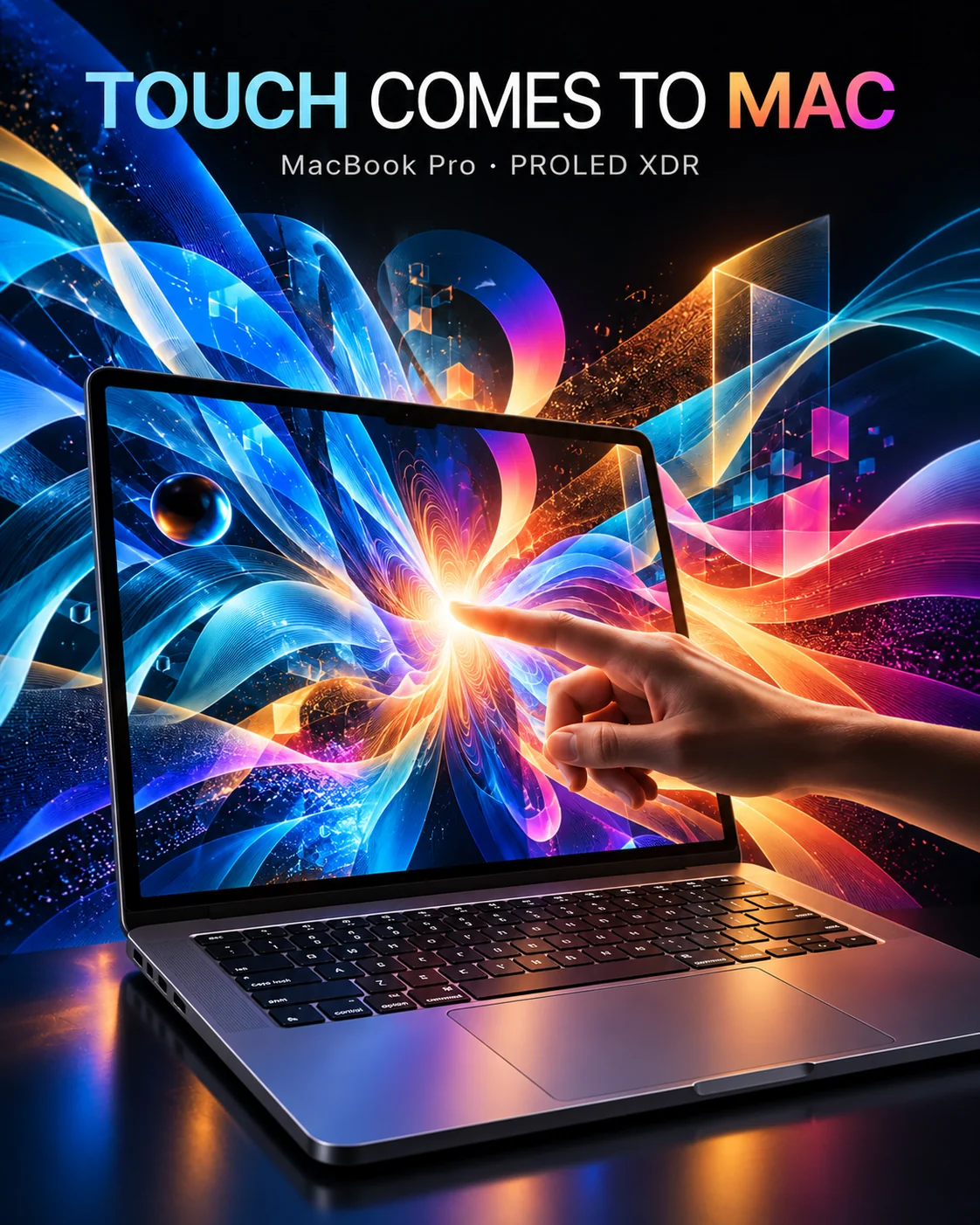
The actual story.
Apple introduced its first touchscreen Mac on October 28: 14- and 16-inch MacBook Pro models with PROLED XDR displays and M5 Pro or M5 Max chips. U.S. starting prices are $2,899 and $3,399 respectively for M5 Pro configurations. Preorders opened October 28; availability begins November 6.
“We brought Touch to the Mac!” Tim Cook wrote on X on October 28.
Loading this post connects your browser to X. X’s privacy policy applies.
Apple says many existing apps work immediately because macOS translates touches into clicks. Developers can also build interactions specifically for touch. That distinction matters: an app accepting a tap is not necessarily designed for fingers, and familiar keyboard shortcuts and trackpad controls still have a role.
PROLED XDR uses tandem OLED, with two light-emitting pixel layers. Apple’s live product page shows scrolling, pinching, rotating and drawing directly on the display. For visual work, that offers another way to manipulate what is onscreen; it does not establish that reaching across a keyboard will be faster or more comfortable for every task.
The touchscreen models are distinct from the M6 MacBook Pro with a Liquid Retina XDR display. A newer chip name alone does not identify the touch model. Before choosing a machine, check the exact display configuration and try the apps and gestures that matter to your work. Independent testing will be useful for judging sustained comfort and practical gains beyond Apple’s demonstrations.
Treat touch as another input option. Test it in your actual workflow before paying for the PROLED XDR model.
Receipts, not rumors.
- Apple announcement — October 28, 2026
- Apple — live PROLED XDR product page
- Tim Cook — original October 28 X post
Read the original reporting: Apple Newsroom; Apple product page; Tim Cook on X
The reporting above provides context. Illustrations are editorial interpretations, not source photographs.
What’s your take?